Friday, 28 October 2011

subjective

BODY CHART
HPC
BEHAVIOUR
PMH
DH
SH

BODY CHART
what where [n] [s] abnormal sensation/movement relationship
HPC
when did it start any change getting better/worse
BEHAVIOUR
aggravating easing irritability 24 hour cycle anything you cant do standard day
PMH
previous probelms intervention sucess
general health
previous problems (screen if say no)
DH (screen if say no esp steroids)
current medication
previous medication
SPECIAL QUESTIONS
Rheumatoid arthritis
Cancer
Vertebrobasiliar insufficiency
Central Cord
SH


pain quality

bone - deep nagging aching
muscle - dull ache
nerve root - sharp shooting
nerve - sharp bright lightening like
sympathetic nerve - burning, pressure-like, stinging aching
vascular - throbbing diffuse

subjective examination

subjective


body chart - what/where/what is pain like [ n ] / vas score [ s ]/ abnormal sensation / relationship of symptoms

hpc - how when did start
change since then

behaviour - aggravating
easing
irritabilty
24 hour behaviour
functional activity / daily tasks
pmh - previous attacks - effect of treatment
general health
previous health problems (screen if say no?)

special questions - rheumatoid arthritis ?
weight loss - cancer
pins needles in both feet / saddle anaesthesia/ bilateral loss of power / legs giving way - (central chord problem)
dizziness drop attacks double vision difficulty swallowing - veterbrobasilar insufficiency

dh - current drugs / past drugs
special questions - steroids, ( screen if no? ) heart medication, inhalers

Tuesday, 20 September 2011

pnf

movements:

rhythmic initiation - warm up, getting things going, judging lever length, passive then active assisted

combination of isotonics - demand concentric muscle action - isometric in middle , eccentric on way down

reversal of agonists :

dynamic reversals - 1 pattern to opposite demand concentric of opposite

stabilising reversals - through small range not too much resistance

rhytmic stabilisation - rotator cuff - isometric "dont let me move you" keep them in one point


hold relax - dont let me move you - } make muscles relax
contract relax - move me - } increase rom


contraindication

acute pain
acute trauma / injury
cognitive impairment
joint stress eg ra ( in non flare up - judgement call)

Saturday, 17 September 2011

elbow - movements & muscle

http://www.studystack.com/flashcard-234813

elbow flexion :- bicpes, brachialis, brachioradialis
elbow extension :- anconeus, triceps
pronation :- pronator teres, pronator quadratus
supination :- supinator, biceps

wrist flexion :- flexor carpi radialis, flexor carpi ulnaris, palmaris longus
wrist extension:- extensor carpi radialis longus, extensor carpi ulnaris, extensor carpi brevis
radial deviation :- extensor carpi radialis, flexor carpi radialis , extensor pollicis longus and brevis
ulnar deviation :- extensor carpi ulnaris, extensor carpi brevis


Friday, 28 January 2011

Journals

spinal cord injury rehabilitation in post-earthquake Haiti: the critical role for non governmental organisations Landry 2010 physiotherapy

criticism - narrative account based on personal experiences framed in context of statistical survey of injuries following haitian earthquake - largerly first person explanation based on personal impressions of working with only 19 haitians of 200 estimated

-what i learned - spinal cord lesions complete have different outcomes from partial spinal cord lesions ( all returned home in 4 months with ambulatory aids )

- follow up - In addition, there are several clinical syndromes associated with incomplete spinal cord injuries.
  • The Central cord syndrome is associated with greater loss of upper limb function compared to lower limbs.
  • The Brown-Séquard syndrome results from injury to one side with the spinal cord, causing weakness and loss of proprioception on the side of the injury and loss of pain and thermal sensation of the other side.
  • The Anterior cord syndrome results from injury to the anterior part of the spinal cord, causing weakness and loss of pain and thermal sensations below the injury site but preservation of proprioception that is usually carried in the posterior part of the spinal cord.
  • Tabes Dorsalis results from injury to the posterior part of the spinal cord, usually from infection diseases such as syphilis, causing loss of touch and proprioceptive sensation.
  • Conus medullaris syndrome results from injury to the tip of the spinal cord, located at L1 vertebra.
  • Cauda equina syndrome is, strictly speaking, not really spinal cord injury but injury to the spinal roots below the L1 vertebra.

Sunday, 26 December 2010

neurological weakness - emergency


emergency evaluation of neurological weakness


summary tables


advanced elbow anatomy


descriptions

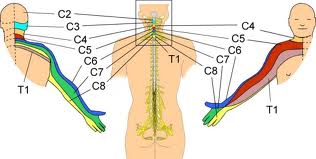
elbow neurology


elbow injuries

olecranon bursitis (students elbow)

lateral epicondylitis ( tennis elbow)

medial epicondylitis ( golfers/throwers elbow)

hyperextension injury

entrapment of radial nerve - tinels sign for radial nerve

entrapment of ulnar nerve - tinels sign for ulnar nerve

(entrapment of median nerve - phalens Test - can be reversed)

inflammation of biceps tendon

inflammation of triceps tendon

medial elbow ligament strain

elbow dislocation - radius/ulna both - 2nd most common after shoulder - posterior dislocation most common - associated with FOOSH - often associated with fracture - subluxation is small degree - complete dislocation requires manipulation


neurological examination - extended


look - inspect for tremors muscle twitches (fasciltations)
posture ( hypertonia UL flexion LL extension)

feel - muscle wastage

move


look for tone (smooth resistance to passive force)
power ( dominant side normally stronger )
coordination - rapid alternating movements
/ point to point - eyes open => cerebellar - eyes close => proproception
walking - hopping - narrow lunging
romberg - cerebellar/position sense
pronator drift - downward drifting ( mild hemiparesis - less severe than
hemiplegia)
sensation tests ( missing from main
reflexes - biceps reflexes triceps reflex briachoradialis
knee reflex ankle reflex ( babinski )

special tests

neurological examination - screen

3 minute

elbow normal range of motion

flexion 140-150

objective elbow exam

objective elbow exam

1. Working Hypothesis

2. Plan & Consent

3. Look :

3.1. General Obs

3.2. Acute Obs

4. Neurological screen

5. Feel - Palpation

6. Move :

6.1. A.P.R
A. In standing bilateral arms abducted 90 degrees ask to flex and extend
supination elbows flexed and touching side thumbs up
P omit if no problems in A.
R.


6.2. specialised tests
tinels sign


6.3. functional tests


7. Review


Saturday, 25 December 2010

Shoulder - normal range of motion

flexion 160-180 degrees


objective neuromuscular exam - structure


1. Working Hypothesis

2. Plan & Consent

3. Look :

3.1. General Obs
3.2. Acute Obs

4. Neurological screen

5. Feel - Palpation

6. Move :

6.1. A.P.R

6.2. specialised tests

6.3. functional tests

7. Review


detail

1. working hypothesis - based on subjective exam....
2. advice and consent - given and obtained
3. look
1. general obs watch patient walk in and sit down
2. acute obs s.s.d.a.b.s
symmetry/posture swelling discolouration
atrophy/muscle bulk bone defects/deformity
scars

5. feel - palpation
everything from s.s.d.a.b.s plus
temperature
tenderness ( indurated or weak areas )
crepitus

6. move
active
passive
resisted

background to a.p.r. compare - be aware of fixed joints - be aware of paralysis

specialised tests
functional tests

review - have i got all info - have i made comparisons - have i got divergent measurements - can i report findings

General Principles of examination

general principles

look feel move

look = symmetry s.s.d.a.b.s.
swelling
discolouration
atrophy
bone defects
scars

feel = temperature
tenderness
crepitus

move = active a.p.r compare fixed or paralysis
passive
resisted
compare
look for fixed joints
paralysis

specialised tests

Common Shoulder Injuries

muscle testing

muscle tests


Shoulder Examination

6.1 . AROM +

6.2 PROM (Scapula stabilised => gleno exam )

6.3. special tests
3. slap tear (kuhns)